- Says who?by Bint Abdul Khaliq Brother,You cant gro...
- ABC of Parenting
- A brilliant explanation of “thoughts” by Ibn Qayyi...
- In the Sight of ALLAH
- Why would Allah forgive a big sinner like me?
- Going with the FLOW
- 11 pieces of advice to help in winning hearts
- The Month of Sha'ban: A Preparation for Ramadaan
- Ramadaan: Save the Changes
- The Smart Husband, The Angry Wife, The Fast Hand A...
- August 2004
- September 2004
- October 2004
- November 2004
- December 2004
- January 2005
- February 2005
- March 2005
- April 2005
- May 2005
- June 2005
- July 2005
- August 2005
- September 2005
- October 2005
- November 2005
- December 2005
- January 2006
- February 2006
- March 2006
- April 2006
- May 2006
- June 2006
- October 2006
- January 2007
- August 2007
- October 2007
- November 2007
- December 2007
- January 2008
- October 2008

It is human nature to be forgetful
'He is only called man (insân) because of his forgetfulness (nasiyân), and it is only called the heart (al-qalb) because it changes so rapidly (yataqallib).'
In the past they said that the first one to forget (awwal nâsin) was the first man (awwal al-nâs), meaning Adam, peace be upon him. Forgetfulness is something that varies from person to person according to each individual's nature; some may be more forgetful than others. Some of the things that may help to combat forgetfulness are the following:
1. Keeping away from sin, because the bad effects of sin result in a bad memory and the inability to retain knowledge. The darkness of sin cannot co-exist with the light of knowledge. The following words were attributed to al-Shâfi'î, may Allâh have mercy on him:
'I complained to [my shaykh] Wakî' about my bad memory, and he taught me that I should keep away from sin. He said that knowledge of Allâh is light, and the light of Allâh is not given to the sinner.'
Al-Khatîb reported in al-Jâmi' (2/387) that Yahya ibn Yahya said:
'A man asked Mâlik ibn Anas, 'O Abu 'Abd-Allâh! Is there anything that will improve my memory?' He said, 'If anything will improve it, it is giving up sin.'
When a person commits a sin, it overwhelms him and this leads to anxiety and sorrow which keeps him busy thinking about what he has done. This dulls his senses and distracts him from many beneficial things, including seeking knowledge.
2. Frequently remembering Allâh, may He be glorified, by reciting dhikr, tasbîh (saying'Subhan Allâh'), tahmîd ('Al-hamdu Lillâh' ), tahlîl ('Lâ ilâha ill-Allâh') and takbîr ('Allâhu akbar'), etc.
Allâh says (interpretation of the meaning):
"And remember your Lord when you forget" [al-Kahf 18:24]
3. Not eating too much, because eating too much makes one sleep too much and become lazy, and it dulls the senses, besides exposing one to the risk of physical diseases. Most of the diseases which we see result from food and drink.
4. Some of the scholars have mentioned certain foods which increase the memory, such as drinking honey and eating raisins and chewing certain kinds of gum resin.
Imâm al-Zuhrî said:
'You should eat honey because it is good for the memory.'
He also said:
'Whoever wants to memorize hadîth should eat raisins.' (From al-Jâmi' by al-Khatîb, 2/394)
Ibrâhîm ibn [sth. omitted] said,
'You should chew resin gum, because it is Ways To Strengthen One's Memory '
As they mentioned, too much acidic food is one of the causes of laziness and weak memory.
5. Another thing that can help the memory and reduce forgetfulness is cupping (hijâmah) of the head, as is well known from experience. (For more information see Al-Tibb al-Nabawi by Ibn al-Qayyim). And Allâh knows best.
by Brother Yahya Adel Ibrahîm "
¶
11:49 PM
//



By: Ahmad Abdulkader Admani, Faisalabad
In the final year of High School, with only a few days left for the final exams, dad promised that if I passed he would agree to pay for a tour of Europe. The days went by. The exams came, I passed. The world was not large enough to contain my happiness, I was crazy. I informed everyone of the good news, even those who did not understand Arabic. Even the garbage men would not get by me without hearing it. In fact, most of them got a hug. I made it home. The walls were dancing and swaying left and right. Everyone was happy. After lunch, I reminded dad of his promise and gave him a polite lecture on the importance of keeping promises. He agreed. And with a big proud smile, he placed his hand in his pocket and removed his checkbook. I applied for a European tourist package. O, how quickly the time went. In the air, I began to daydream. At last, I had left my land, to finally experience a free country.
We landed.
Everything was prepared by the time we arrived: the hotel, an itinerary of what we were going to do and see. It was a strange world, the echo of drunks and lost souls slipped in from our hotel windows.
Do not ask me what I did. I did everything - everything! Everything - that is - except Salah and recitation of the Qur'an. There was no time for that. If not for the curves of my face and the brown texture of my Arab skin everyone would have thought I was European. My walk, my stance, my clothes, my words. Everything howled to the world that I was indeed a European, except for my face and color.
My new friends all adored me. The group leader, the female guide, our group councilor, the participants, men and women. All of them, without exception, cherished my jokes and company.
The tour moved along:
There was only one day left and, as the schedule stated, they were planning a trip to the countryside. There, they would hold the final ceremony. On that day, the bus arrived at our hotel and transported us to the countryside.
The land was a green Persian carpet, magical. Fillets of flowers splashed here and there.
The day fell away and the sun began to set. It slipped behind two mountains and the sky put on a grey cloak to mourn the passing daylight. At that moment - a night of romance and the sighs of lovers rose. Dreamy music filled the sky, mingling with the pleasure of its audience.
After that, the Master of Ceremonies announced the commencement of the farewell ceremony. And to begin, the best participant medal would be awarded.
The group leader stood up and held the microphone in his hand to announce the winner.
Everyone held his breath. Not a stir.
He announced, "The ideal participant of our tour this year is "Mazen Sa'id!"
A cheer roared up, clapping and whistling ignited from all around. I just could not believe my ears. Shaken, it felt like I was underwater or something.
Only when the other participants hoisted me up did I snap out. The celebration carried me off. No sign of cheer could be found on my face I though immediately, why had they chosen me when there were so many other participants who confessed the same European religion? Was it because I was Muslim that they chose me? I continued to ask myself repeatedly - why, why? I began remembering my father and his prayer, my mother and her recitation. I remembered the Imam of our Masjid, his speech about traveling out of the country.
I remembered the tape my friend gave to me. It was about Christian missionary work.
I remembered the Messenger of Allah. I imagined him in front of me, watching, what was I going to do?
I reached the podium.
The group leader held in his hands a gold cross medal.
His snicker shimmered of jealousy and malice. He stepped towards me, giggling in victory.
He held my neck and placed the cross
Stop! I'm Muslim! I grabbed the gold cross and threw it at his face. It fell to the ground and I trampled it under my foot.
I ran away. Far, far away. Tears on both sides of my cheeks slipped down.
I climbed a hill until I reached the top.
I began screaming to the ear of the universe. The world could hear me?
Allahu Akbar, Allahu Akbar, Ashadu Al Lailaha illa Allah, wa Ashadu anna Muhammadur Rasullulah.
(Allah is the greatest, Allah is the greatest. I bear witness that there is no deity but Allah, and I bear witness that Muhammad is the Messenger of Allah)
¶
9:22 PM
//

Sabr or Shukr ~ The Worry Stops Here..
transgressive people."
It was narrated that when she said this, the sky opened for her and she saw her home in Paradise. She smiled. The guards watched astonished, she's being tortured and she smiles? Frustrated, Fir'own commanded a boulder to be brought and dropped on Aasiyah, to crush her to death. But Allah took her soul before the boulder was brought and she became an example for all the believing men and women till the end of time:
[And Allah has set forth an example for those who believe: the wife of Fir'own (Pharaoh) - when she said, "My Lord, Build for me a home with You in Paradise, and save me from Fir'own and his deeds, and save me from the transgressive-disbelieving people.] -Tahreem 66/11
In the hadith of Jibreel, when he came to the Prophet (SAL ALLAHU ALAYHI WA SALLAM) and asked him about Islam, Eeman, and Ihasan, the Prophet SAL ALLAHU ALAYHI WA SALLAM said about Eeman, "Eeman is to believe in Allah, His angels, His books, His Messengers, the Final Day, and the divine decree, the good and the bad thereof."
For the past few weeks we have been reflecting on this hadith, only glimpses. Today we shall conclude with the last article of Eeman: to believe in the Divine decree, the good and the bad thereof.
As you and I travel though life we find ourselves in one of two situations. Either something good is happening in our lives and in which case - as Muslims- our role is to thank Allah for the blessing. Or something bad is happening to us, something we dislike and our role here is to be patient (Sabr). This is the formula for a happy life, a life cruising towards the pleasure of Allah. Sabr or Shukr, the worry stops here.
The Messenger of Allah (SAL ALLAHU ALAYHI WA SALLAM) said, "Strange is
the affair of the Mu'min (the believer), verily all his affairs are good for him. If something pleasing befalls him he thanks (Allah) and it becomes better for him. And if something harmful befalls him he is patient (Saabir) and it becomes better for him. And this is only for the Mu'mmin "
Ibn Al-Jowzee said, "If this Dunya was not a station of tests it would not be filled with sicknesses and filth. If life were not about hardship, then the Prophets and the pious would have lived the most comfortable of lives. Nay, Adam suffered test after test until he left the Dunya. Nuh cried for 300 years. Ibrahim was thrown into a pit of fire and later told to slaughter his son. Ya'qub cried until he became
blind. Musa challenged Fir'own and was tested by his people. Eeasa had
no provision except the morsels his disciples provided him with. And Muhammad (Sal Allahu Alayhi wa Sallam) met poverty with patience, his uncle - one of the most beloved relatives to him - was slain and mutilated and his people disbelieved in him ... and the list of Prophets and the pious goes on and on."
What happens to us happens by the will of Allah. It is an article of our Eeman in Qada' and Qadr that we are pleased with Allah's choice, Good or seemingly bad it is all the test of this Dunya. How could we imagine that we shall not be tested when those who were better than us suffered what they suffered. They however came away with the pleasure of Allah, Subhaanahu wa Ta'Aala.
Al Hasan ibn Arafah narrated, "I visited Imam Ahmad ibn Hanbal after he was whipped and tortured. I said to him, "O Abu Abdillaaah, you have reached the station of the Prophets!" He said, "Keep quiet. Verily, I saw nothing more than people selling their Deen. And I saw scholars that were with me sell their Faith. So I said to myself, 'Who am I, what am I. What am I going to say to Allah tomorrow when I stand in front of Him and He ask me, "Did you sell your Deen like the others did?" So I looked at the whip and the sword and chose them. And I said, "If I die I shall return to Allah and say: 'I was told to say that one of Your Characteristics was something created but I did not.' After that, it will be up to Him - either to punish me of be Merciful on me."
Al-Hasan ibn Arafah then asked, "Did you feel pain when they whipped you?" He said "Yes, I felt the pain up to 20 lashes then I lost all feeling (They whipped him over eighty times). After it was over I felt no pain and that day I prayed Dhuhr standing."
Al-Hasan ibn Arafah started weeping when he heard what had happened. Imam Ahmad questioned him, "Why are you crying? I did not lose my Eeman. After that why should I care if I lose my life?" They were better than us but this was how they were tested.
Let us discuss some facts about these tests of life, the good and the bad that befalls us:
§ Much of what befalls us - the hard times - is the direct result of ourown sins.
Allah Ta'aala says [And whatever misfortune befalls you it is because of what your hands have earned. And He pardons much.] - Sura 42/30
Muhammad ibn Seereen used to say when his debts piled up and he felt sad, "I know that the cause of this sadness is a sin I committed over 40 years ago."
§ People understand that when something bad happens it is a test from Allah. But dear Brothers and Sisters, the good things that happen to us are also a test.
Allah ta'aala says [And we tested them with good (blessings) and evil (calamities) in order that they might turn back] - A'raf 7/168
Abd alMalik ibn Ishaq said, "There is no one that is not tested with health and prosperity to measure how thankful he is (Shukr)."
And the Companion - AbdurRahman ibn 'Awf (RADI ALLAHU ANHU) said, "We
were tested with hardship and were patient. And then we were tested with prosperity and we were not patient. Because of this Allah states:
[O ye who believe! Let not your wealth or your children divert you from the remembrance of Allah. And whosoever does that, then they are the losers.] - Munafiqun 63/9
§ Patience must happen from the beginning, not three days later or one day later, at the first news of the calamity, when it first happens.
The Prophet (SAL ALLAHU ALAYHI WA SALLAM) said, "Verily patience (is only Sabr when practiced) at the first hit (of news)."
§ There are things that contradict Sabr. Tearing ones shirt, for example, slapping ones face, slapping hands, shaving ones head, and cursing and wailing.
Umm Salamah narrates: I heard the Messenger of Allah (SAL ALLAHU ALAYHI WA SALLAM) say, "Any Muslim that says when a calamity befalls him that which Allah commanded him: To Allah we belong and to him we return. O Allah reward me in this calamity and give me better then it - (any Muslim that says this) Allah will grant him better than (that which he lost)." - Muslim
§ These tests and hardships wash our sins. Aisha (RADI ALLAHU ANHA) said, "Verily fever sheds sins like a tree sheds leaves."
§ The hardships that befall us distinguish the believers from the insincere. Shumayt ibn Ajlaan said, "The pious and the ungrateful are hidden by health. Yet when calamities befall the two men are separated (by how they react)."
Allah says in the Quran [Alif/Laam/Meem..Do people think that they will be left alone because they say, "We believe," and will not be tested? Indeed We tested those who (lived) before them] Al-Ankaboot 29/1-3
Part II: Towards Sabr
Ali (RADI ALLAHU ANHU) said, "Verily Sabr is to Eeman what the head is to the body. When the head is cut off, the body falls. (He then raised his voice) Verily there is no Eeman for he who has no Sabr (patience)."
There are three types of Sabr that the Muslim must have:
a. Sabr in the obedience of allah. For example, One must be patient and perform their Fajr at it's time.
b. Sabr in not disobeying Allah. Like someone might say, "I just have to insult him." No, we are command by He who gave us our tongues to not follow the whispers of Shaytaan. And we must have Sabr in not disobeying Allah.
c. Sabr in what Allah Decrees on us. For example, if our child was to pass away we should be patient and seek the reward of Allah in our patience and say only that which is pleasing to Allah.
There are two keys. If we understand them we shall open the door to Sabr in our lives:
The First Key: know that our souls, families and wealth do not belong to us, they belong to Allah. He gave it to us as a loan to see what we would do with it. And when he takes it back He is taking back what belongs to Him. We had nothing before the blessing and we'll have nothing after it. We did not create the blessing from nothing, so how can we claim that it belongs to us.
The Second Key: We are on a journey and the destination is the hereafter - Paradise or Hell. We shall be leaving the Dunya behind us and we'll come back to Allah by ourselves. This is what needs our focus. And if Allah is pleased with us then no worry. If He is not pleased with us then all worry.
Let me draw your attention to a verse. Listen carefully. Allah revealed:
[Guard strictly the (five obligatory) prayers, especially the middle Salah and stand before Allah in obedience.]- alBaqarah 2/238
The verses before this deal with divorce. The verses after it deal with divorce. Why was this verse placed in the middle?
The Ulama' have suggested, Wa Allaahu a'lam, that in the hard times that a person goes through (especially in a divorce) they should not forget the remembrance of Allah, the Salah. And it is that Salah coupled with Sabr that will pull them through.
[O you who believe! Seek Help in Patience and Salah. Truly, Allah is with those that are patient.]-Baqarah 2/153
In conclusion, Allah ta'ala wants us to give pass on the following good news:
[And give good news to the patient who, when afflicted with calamity say, "Truly, to Allah we belong and truly, to Him we shall return."/They are those on whom the Salawat (i.e. the blessing and forgiveness) of their Lord is upon them, and who shall receive His Mercy, and it is they who are the guided ones] -Baqarah 2/157
Allah promised anyone who wants to work on his or her patience three things: Forgiveness, Mercy, and guidance.
Who could ask for more?
¶
1:13 PM
//
OH MY CREATOR!
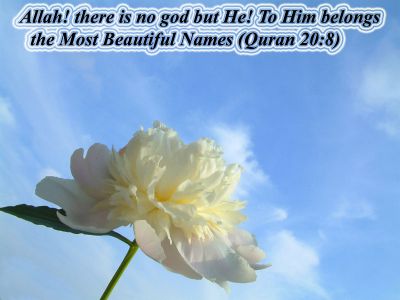
I need Your help YA RAHMAN, please help me, I am falling
I crave Your mercy YA RAHEEM, without YOU I am nothing
I need strength from YOU ,YA QADIR; it's so easy to slip
I need wisdom from YOU , YA HAKEEM, from Your fountain grant me a sip
I need courage to fight YA KABEER, to fight my nafs and the cursed shaitaan
I need true Knowledge YA 'ALEEM, to be from those who have pure Imaan.
I need Your light YA NOOR,I am groping in the darkness
I need Your guidance YA BASEER , please lift from me my blindness
I ask of YOU ,YA RAZZAQ, for it is YOU who provides
I need peace from YOU ,YA SALAAM, so that my restlessness subsides
I beg of Your forgiveness YA GHAFFAR, my sins fill me with utter shame
My wrongdoings are so many YA WAASIT, Too many for me to name
I am scared YA HAAFIZ, I beg of Your protection
Imbue me with Gratitude YA SHAKOOR, and my heart with love and affection
I am weak YA QUDDOOS; I am drowning in the oceans of my greed
I ask Hidaya from YOU , YA MU'EZ, Verily I am in need
Please hear my cries YA MUJEEB, No one else can I turn to
I submit to YOU , YA ALIY, for there is NONE Higher than YOU
I bow my head in Awe of YOU , YA 'AZEEM, please accept my Dua
And never leave me for even a second Oh My Creator,Oh My most Loving ALLAH!
Subhanaka Rabbil I'zzati 'Amma Yasifoon
WaSalaamun Alal Mursaleen.
Walhamdulillahi Rabbil A'aalammen
Birahmatika Ra YA Arhamar Raahimeen.
¶
1:58 AM
//
If You Wish To...

Be wise, fear Allah and obey His commands.
Be obedient, fulfill your duties to Allah and His creation.
Be the best amongst people, help other people
Be fair with people, like for others what you like for yourself.
Have your prayers come true, remember Allah and He shall remember you.
Be close to Allah, refrain from eating, talking, acting, and doing the Haraam.
Allah to have mercy on you, then be kind and merciful to His creation.
Rid yourself of Gunaah, recite Astaghfirullah habitually.
Rid yourself of the Hell Fire, offer salaat 5 times everyday, and be steadfast with your Fasting.
Worship Allah as if you see Him.
If you cannot achieve this state of devotion then consider that He is watching you.
¶
3:06 PM
//
And They Called it Women's Liberation
By Areeba bint Khalid
Posted: 9 Jamad-ul-Awwal 1424, 27 June 2004
From the 1800s to the present day, family life in the West has remarkably changed. While the West calls this change part of the women freedom movement, a look at history may show otherwise.
America before the 1800s was a farming country and ninety percent of the population lived and worked on private farms. Households were mainly self-sufficient--nearly everything needed was produced in the house. The few things that could not be produced at home were bought from local craftsmen. Some other things, especially imports from Europe, were bought from stores. Males would take care of the fields and females would take care of the home. In addition, they would engage in spinning, knitting, weaving, and taking care of the farm animals.
Industrial Revolution
The Industrial Revolution, which began around the early 1800s, brought a major change to this way of life. In 1807, in the wake of the war between Great Britain and France, President Jefferson signed the Embargo Act, which stopped all trade between Europe and America. The Act meant that European goods would no longer be available in the US and Americans would have to produce them. One major European import to America was cloth, and so merchants used this opportunity to create a cloth industry in America.
In 1814, Francis Cabot Lowell, a man from Boston opened the first modern factory. Work here was to be done way faster than before. Instead of manually making things in houses, things were to be made at higher speeds in a factory and all stages of the work were to be completed under the same roof. Now what Lowell needed were workers. He found out that women, especially unmarried daughters of the farmers, were more economical to use in labor than men. They were also more willing to work as hired people in factories.
But Lowell had to make the working outside of home acceptable in a society which was not used to it. He assured parents that their daughters would be taken care of and kept under discipline. And he built a boarding community where the women workers lived and worked together.
Soon after, more and more factories emerged across America. Factory owners followed Lowell's example of hiring unmarried women. By 1850 most of the country's goods were made in factories. As production of goods moved from the country to the city, people too moved from the country to the city.
For money to be earned, people had to leave their homes. When women worked on the farm, it was always possible to combine work and family. When work for women moved outside the home, however, the only women who could follow it were those without family responsibilities or those who had no husband or no income. Likewise, the only women who could take care of their families were the ones that didn't have work.
This working out of home became a part of life for unmarried women. They would work until their marriage. But as time passed, women found family life interfering with their work life and instead of viewing working out of home as optional, they viewed family life as such. Many women started delaying marriage even more and some decided to stay single.
Married women however stayed home and dedicated their time to their children. Now that there wasn't any farm work to do, women had even more time to spend with the children. In 1900 less than about 5.6% of married women worked outside. If a married woman were to work, it would be considered that her husband was invalid or that she was poor.
World War I
The first major entry of married women to the workforce came during World War I in 1914. Men went to fight the war and the country needed workers to take over the jobs they left behind. Unmarried women were not sufficient for the labor needs, so employers started to invite married women too, to work. By 1919, 25% of the women in the workforce were married. But this was only the beginning.
Another change World War I brought was the entry of women to the army. About 13,000 women enlisted in the US Navy, mostly doing clerical work--the first women in US history to be admitted to full military rank.
Great Depression
The Great Depression came in the 1930s. The unemployment rate climbed from 3.2% in 1929 to 23.6% in 1932. Jobs became scarce for skilled people and men. Fathers went to search for jobs. Some, under despair, deserted their families. The responsibility of earning fell on mothers in many families.
Most women and children, however, found jobs more easily than men because of the segregation of work categories for men and women. Although 80% of men during the Great Depression opposed their wives entering the workforce under any circumstances, economic factors made it necessary for the women to work. Hours were long and pay was low. Twenty percent of white women were in the workforce.
World War II
World War II came in the early 1940s. Men were drafted to fight, and America needed workers and supplies. Again, the employers looked towards the women for labor. Unmarried and married women were invited to work, as had been done during World War I.
But still, public opinion was generally against the working of married women. The media and the government started a fierce propaganda campaign to change this opinion. The federal government told the women that victory could not be achieved without their entry into the workforce. Working was considered part of being a good citizen, a working wife was a patriotic person.
The government founded the Magazine Bureau in 1942. The Bureau published Magazine War Guide, a guide which told magazines which themes stories they should cover each month to aid war propaganda. For September 1943, the theme was "Women at Work". The slogan for this was "The More Women at Work the Sooner We Win." Magazines developed stories that glorified and promoted the placement of women into untraditional jobs where workers were needed. The idea was that if smaller, unexciting jobs were portrayed as attractive and noble more women would join the work force.
The media created Rosie the Riveter, a mythical character to encourage women into the workforce. Rosie was portrayed as a patriotic woman, a hero for all American women. "All the day long, Whether rain or shine, She's a part of the assembly line. She's making history, Working for victory, Rosie the Riveter… There's something true about, Red, white, and blue about, Rosie the Riveter."
The propaganda efforts worked. More than six million women joined the workforce during the war, the majority of them married women. In 1940, before the war, only 36% of women workers were married. By 1945, after the war, 50% of women workers were married. The middle class taboo against a working wife had been repealed.
Post World War II
The 1950s marked an era of prosperity in the lives of American families. Men returned from war and needed jobs. Once again, the government and media got together to steer the opinion of the public. This time, however, they encouraged women to return home, which shows that the women were brought out not for their freedom but because workers were needed.
But this effort was not as successful and was abandoned quickly. First, women from lower economic ranks had to remain in the workforce because of economic necessity. And second, there came the rise of consumer culture.
The baby boom took place during the 1950s as well. Women who returned home dedicated their lives once again to their children. But around the same time an important change had come in the American life. This was the spread of the television. By 1960, 90% of the population owned at least one set. Families would gather around the screen for entertainment. In the early days, everything including commercials was watched with great interest.
Most middle-class families could not afford the goods the television declared necessary to maintain or enhance quality of life with one paycheck alone. Many women returned to work in order to live according to "the American standard of living," whatever that meant to them.
The number of American women in the workforce from 1940 to 1950 increased by nine percent. From 1930 to 1940 there had only been a three percent increase.
Effects
As mothers returned to work, the television became the most important caretaker of a child. Children in the 1950s spent most of their non-sleeping hours in front of the television screen.
In 1940, less than 8.6% of mothers with children under eighteen worked. By 1987, 60.2% of women with children under eighteen were working.
As wives assumed larger roles in their family's financial support, they felt justified in demanding that husbands perform more childcare and housework. Across the years, divorce rates doubled reaching a level where at least 1 out of 2 marriages was expected to end in divorce. Marriage rates and birthrates declined. The number of single parent families rapidly increased. People grew unhappy with their lives, when compared to the lives of people on television.
Women working affected the society in many different ways. The first and most important of these was that children with working mothers were left alone without the care of a mother. As the number of working women increased, the number of children growing up unsupervised increased, and with this increased crime among teens.
Since most women placed their career ahead of family life, family life was greatly affected since unmarried women were generally able to make more money than married ones. For example, according to a study by a Harvard economist, women physicians who were unmarried and had no children earned thirteen percent more per year than those who were married and fifteen percent more than those with children.
Today
The majority of women still work at the lower levels of the economic pyramid. Most are employed in clerical positions, factory work, retail sales, or service jobs. Around 50% of the workforce is female. While about 78% of all cashiers and 99% of all secretaries today are female, only 31% of managers and administrators are female. Equality in the workplace has been a mirage but it has conned millions of women into leaving their homes and destroying the family structure.
It was only when economic or political factors made it necessary to get more workers that women were called to work. The Industrial Revolution, the Great Depression, and the World Wars, all the major events which increased the proportion of women workers, were times when the capitalists required more workers in order to be successful in their plans and so they used women.
The move of women from home to the public workforce has been gradual. First poor women went. Then unmarried women. Then married women without children. Then married women without young children And then, all women. The same thing can be seen to be happening in developing countries around the world, as the West spreads its propaganda of freedom for women to work. The results of this move will probably be the same too.
Bibliography
-Hawes, Joseph M., ed. American Families: A Research Guide and Historical Handbook. New York: Greenwood Press,- 1990.
-Mintz, Steven. Domestic Revolutions. New York: the Free Press, 1988.
-Gary B. Nash, American Odyssey. New York: Glencoe McGraw-Hill, 2002.
-Wilson, Margaret Gibbons. The American Woman in Transition. Connecticut: Greenwood Press, 1979.
-Goldstein, Joshua S. War and Gender: How Gender Shapes the War System and Vice Versa. Cambridge University Press, 2001.
-U.S. Department of Labor, Women's Bureau. Women in the Force, 1900-2002. http://www.infoplease.com/ipa/0/1/0/4/6/7/A0104673.html
-The Library of Congress Rosie the Riveter: Real Women Workers in World War II http://www.loc.gov/rr/program/journey/rosie-transcript.html
¶
6:16 AM
//
Fair Ladies for the Altar
It happened soon after Muslims conquered Egypt in 20 A.H. A delegation of the local Copts approached the governor Umro bin al-a'as, Radi-Allahu unhu, with a pressing matter. While life in Egypt depended upon the Nile, the river itself demanded an yearly human sacrifice. To satisfy this requirement, on the 12th night of June a virgin girl was dressed as a bride then thrown into the river. Otherwise the river would drop to a trickle. His response was immediate. The river would have to do without the human sacrifice. Islam destroys all superstitions and rites of Ignorance.
Days passed. Then weeks. Then months. The river remained dry. Caught between a river that "demanded" human sacrifice, and the new rulers who would not permit it, the people prepared to migrate. Seeing this Umro bin al-a'as wrote to Khalifa Sayyidna Umar, Radi-Allahu unhu. "You did the right thing," Sayyidna Umar wrote back. "Islam does destroy all rituals of Ignorance. I am sending you a note. Drop it into the river." The note was a letter to the river. It read: "From the servant of Allah, Ameerul-Momineen Umar to the Nile of Egypt. If you were flowing of your own accord then you can stop flowing. But if it is Allah, the One, the Almighty, Who makes you flow, then we pray to Him that He should force you to start flowing again."
And so it happened, writes historian Ibn Taghri Berdi in "An-Najum uz-zahira fi akhbar muluk Misr walqahira." (Vol. 1, p. 35). Governor Umro bin al-a'as dropped the letter into the river and the next morning the Nile had started flowing at its full level. Islam had liberated the women in Egypt from the tyranny of a terrible pagan practice.
Human sacrifice in one form or another was common to all pagan societies. A very large number of these sacrifices involved women. They were thrown into rivers or lakes (to appease these vital sources of life), buried alive in the foundations of bridges (to make the bridge strong), or just offered as sacrifice to the gods for the protection of the community.
The game London Bridge Is Broken Down, and the accompanying rhyme, preserve unmistakable traces of human sacrifice at the building of a bridge. The bridge has fallen down, and all rebuilding attempts will fail, whereupon follows -- with an apparent lack of connection -- the arrest of a woman prisoner.
London Bridge has fallen down, fallen down, fallen down,
Build it up with lime and stone ...
Stone and lime would wash away ...
Build it up with iron bars ...
Iron bars would bend and break ... etc. etc.
What has this poor prisoner done? ...
Off to prison she must go.
My fair lady!
Ibn Battuta gives an account of the practice in pagan Maldive Islands. Every month a young virgin girl was dressed up then left overnight in a temple on the shore to appease a ginni. In the morning they would find the girl dead and violated. A Muslim visitor Abul Barkat Berberi learned about it from his host, an old woman whose only daughter had been drafted for the next sacrifice. Abul Barkat, who was a hafiz, offered to go in her place. In the temple he kept reciting the Qur'an all night. When they found him alive and well next morning, the news spread throughout the island and within a month the entire population had accepted Islam. The woman of another land had been liberated from the pagan tyranny.
The record of Christianity is less clear. First, it endorsed the basic idea of human sacrifice by suggesting that Jesus had died on the Cross to atone for the sins of humanity. Second, it was content to merely change the pagan rites into more benign forms. The earlier offerings of human sacrifices of Saturnalia were replaced by offerings of Christmas gifts. Same with Halloween. Halloween started in Great Britain with the ancient Druid culture. The Druids believed that the witches, ghosts, and evil spirits walked on earth on the night of October 31. They would light huge bonfires to ward off these spirits. They would then go from door to door asking for treats. These "treats" were not candy. They were victims ---young virgins--- for human sacrifices. If the Druids received their "treat" they would leave a lighted jack-o'-lantern at that house as a sign that a sacrifice had been obtained there.
That most of these symbols survive (and thrive) today reminds us that the post-Christian Western civilization remains at heart a pagan civilization, albeit a more polished one. The drastic rituals have been replaced but the crooked ideas behind them survive. What was the idea behind throwing a virgin into the Nile? That a woman must sacrifice her life for the economic prosperity of the society. In forcing the women outside the home and herding them into offices and factories, the Industrial Revolution preserved the same idea. In putting them on display to attract customers, the "Marketing Revolution" preserved the same idea. The women must sacrifice their lives, dignity, and security for the economic prosperity of the society. If it leaves them prey to an avalanche of advances and assaults, so be it. If it destroys the home and family life, so be it. The goddess of "economic progress" demands their sacrifice, and they must submit. Today the woman has been uprooted from her home, separated from her family, violated, left to tend for herself, and expected to be grateful for this "emancipation"!
How can we explain what was going on with the Nile? Perhaps the answer lies in that when a people choose to reject Allah's clear Signs and Commands, then their own chosen path of destruction is made easy for them. "Those who reject Our Signs, We will lead them step by step to ruin while they know not." [Al-A'raf 7:182]. As the Nile remained dry, it was a test of the believers. Would they hold fast to the rejection of all pagan rites or would they waver in the face of an apparent calamity? The letter to the river was a marvelous act. It radiated unwavering faith in Allah and unremitting disdain for pagan beliefs and practices. Only such faith could free humanity from the cruelty of pagan Ignorance.
The test continues. For the women today need to be liberated from the tyranny of modern paganism, just like they needed to be liberated from the tyranny of ancient paganism.
¶
6:08 AM
//
Azaan: [Call to Prayer]..The Amazing Phenomenon

Amazing as it sounds, but fortunately for the Muslims of the world, it is an established fact. Have a look at a map of the world and you will find Indonesia on the eastern side of the earth. The major cities of Indonesia are Java, Sumatra, Borneo and Saibil. As soon as dawn breaks on the eastern side of Saibil, at approximately 5:30 am local time, Fajar Azaan begins. Thousands of Muazzins in Indonesia begin reciting the Azaan.
The process advances towards West Indonesia. One and a half hours after the Azaan has been completed in Saibil, it echoes in Jakarta. Sumatra then follows suit and before this auspicious process of calling Azaan ends in Indonesia, it has already begun in Malaysia.
Burma is next in line, and within an hour of its beginning in Jakarta, it reaches Dacca, the capital city of Bangladesh. After Bangladesh, it has already prevailed in western India, from Calcutta to Srinagar. It then advances towards Bombay and the environment of entire India resounds with this proclamation. Srinagar and Sialkot (a city in north Pakistan) have the same timing for Azaan.
The time difference between Sialkot, Quetta, and Karachi is forty minutes, and within this time, Fajar Azaan is heard throughout Pakistan. Before it ends there, it has already begun in Afghanistan and Muscat. The time difference between Muscat and Baghdad is one hour. Azaan resounds during this one hour in the environments of Hijaaz-e-Muqaddas (Holy cities of Makkah and Madinah), Yemen, United Arab Emirates, Kuwait and Iraq.
The time difference between Baghdad and Alexandria in Egypt is again one hour. Azaan continues to resound in Syria, Egypt, Somalia and Sudan during this hour. The time difference between eastern and western Turkey is one and a half hours, and during this time it is echoed with the call to prayer.
Alexandria and Tripoli (capital of Libya) are located at one hour's difference. The process of calling Azaan thus continues throughout the whole of Africa. Therefore, the proclamation of the Tawheed and Risaalat that had begun in Indonesia reaches the Eastern Shore of the Atlantic Ocean after nine and half hours. Prior to the Azaan reaching the shores of the Atlantic, the process of Zohar Azaan has already started in east Indonesia, and before it reaches Dacca, Asar Azaan has started.
This has hardly reached Jakarta one and half hours later, the time of Maghrib becomes due, and no sooner has Maghrib time reached Sumatra, the time for calling Isha Azaan has commenced in Saibil! When the Muazzins of Indonesia are calling out Fajar Azaan, the African Muazzins are calling the Azaan for Isha.
If we were to ponder over this phenomenon thoughtfully, we would conclude the amazing fact that there is not even a single moment when hundreds of thousands of Muazzins around the world are not reciting the Azaan on the surface of this earth. Even as you read this material right now, you can be sure there are atleast thousands of people who are hearing and reciting the Azaan!!!
Say: He is Allah, the One and
Only, Allah the Eternal, Absolute.
He does not beget, nor is He begotten.
And there is none like Him.
(Soore Ikhlas 112:1-4)
And Allah knows best.
¶
8:02 PM
//
The Sculptor's Attitude

I woke up early today, excited over all I get to do before the clock
strikes midnight. I have responsibilities to fulfill today.
I am important. My job is to choose what kind of day I am going to
have.
Today I can complain because the weather is rainy or...
I can be thankful that the grass is getting watered for free.
Today I can feel sad that I don't have more money or...
I can be glad that my finances encourage me to plan my purchases
wisely and guide me away from waste.
Today I can grumble about my health or...
I can rejoice that I am alive.
Today I can lament over all that my parents didn't give me when I was
growing up or...
I can feel grateful that they allowed me to be born.
Today I can cry because roses have thorns or...
I can celebrate that thorns have roses.
Today I can mourn my lack of friends or...
I can excitedly embark upon a quest to discover new relationships.
Today I can whine because I have to go to work or...
I can shout for joy because I have a job to do.
Today I can complain because I have to go to school or...
I can eagerly open my mind and fill it with rich new tidbits of
knowledge.
Today I can murmur dejectedly because I have to do housework or...
I can feel honored because the Lord has provided shelter for my mind,
body, and soul.
Today stretches ahead of me, waiting to be shaped.
And here I am, the sculptor who gets to do the shaping.
What today will be like is up to me.
I get to choose what kind of day I will have!
¶
7:15 PM
//
Little Red Riding Hood - A Politically Correct Fairy Tale
by Jim Garner
copied by Andy Tiarks April 24, 1993
originally appeared in "Comic Relief" April, 1993
There once was a young person named Red Riding Hood who
lived with her mother on the edge of a large wood. One day her
mother asked her to take a basket of fresh fruit and mineral water
to her grandmother's house -- not because this was womyn's work,
mind you, but because the deed was generous and helped engender a
feeling of community. Furthermore, her grandmother was not sick,
but rather was in full physical and mental health and was fully
capable of taking care of herself as a mature adult.
So Red Riding Hood set off with her basket of food
through the woods. Many people she knew believed that the forest
was a foreboding and dangerous place and never set foot in it. Red
Riding Hood, however, was confident...
On her way to Grandma's house, Red Riding Hood was
accosted by a Wolf, who asked her what was in her basket. She
replied, "Some healthful snacks for my grandmother, who is
certainly capable of taking care of herself as a mature adult."
The Wolf said, "You know, my dear, it isn't safe for a
little girl to walk through these woods alone."
Red Riding Hood said, "I find your sexist remark
offensive in the extreme, but I will ignore it because of your
traditional status as an outcast from society, the stress of which
has caused you to develop your own, entirely valid worldview. Now,
if you'll excuse me, I must be on my way."
Red Riding Hood walked on along the main path. But,
because his status outside society had freed him from slavish
adherence to linear, Western-style thought, the Wolf knew of a
quicker route to Grandma's house. He burst into the house and ate
Grandma, an entirely valid course of action for a carnivore such as
himself. Then, unhampered by rigid, traditionalist notions of what
was masculine or feminine, he put on grandma's nightclothes and
crawled into bed.
Red Riding Hood entered the cottage and said, "Grandma,
I have brought you some fat-free, sodium-free snacks to salute you
in your role of a wise and nurturing matriarch."
From the bed, the Wolf said softly, "Come closer, child,
so that I might see you."
Red Riding Hood said, "Oh, I forgot you are as optically
challenged as a bat. Grandma, what big eyes you have!"
"They have seen much, and forgiven much, my dear."
"Grandma, what a big nose you have -- only relatively, of
course, and certainly attractive in its own way."
"It has smelled much, and forgiven much, my dear."
"Grandma, what big teeth you have!"
The Wolf said, "I am happy with and what I am,"
and leaped out of bed. He grabbed Red Riding Hood in his claws,
intent on devouring her. Red Riding Hood screamed, not out of
alarm at the Wolf's apparent tendency toward cross-dressing, but
because of his willful invasion of her personal space.
Her screams were heard by a passing woodchopper-person
(or log-fuel technician, as he preferred to be called). When he
burst into the cottage, he saw the melee and tried to intervene.
But as he raised his ax, Red Riding and the Wolf both stopped.
"And what do you think you're doing?" asked Red Riding
Hood.
The woodchopper-person blinked and tried to answer, but
no words came to him.
"Bursting in here like a Neanderthal, trusting your
weapon to do your thinking for you!" she said. "Sexist!
Speciesist! How dare you assume that womyn and wolves can't solve
their own problems without a man's help!"
When she heard Red Riding Hood's speech, Grandma jumped
out of the mouth, took the woodchopper-person's axe, and cut
his head off. After this ordeal, Red Riding Hood, Grandma, and the
Wolf felt a certain commonality of purpose. They decided to set up
an alternative household based on mutual respect and cooperation,
and they lived together in the woods happily ever after.
¶
8:35 PM
//
Not Without Her Make-up
and stories generally written about Muslim women by
women from Western non-Muslim backgrounds. It is, to
some extent, an attempt to convey to the readers
>how
it feels to be 'othered' and to be judged
superficially in accordance with only one's own
perceptions. I hope you take it for what it is - a
satire.
>I do not clearly remember the first time I was here.
>My earliest memories
>of Australia start when I was
>around six or seven, probably my first trip after I
>was born in the city of Sydney. My parents were not
>particularly happy with the idea of me growing up
>there. So, they took me out to Iran at the first
>oppo
>tunity.
>
>As I grew up, my impressions of Sydney were formed
>from stories I heard from my parents, shows I watched
>on television and of course, what I saw on my trips.
>From my first trip at the age of seven, I vaguely
>remember the peop
>e I met and the places I visited. I
>remember more from my second trip, though, which was
>at the age of fourteen. I recall my parents warning me
>over and over again about how women were treated in a
>society so fundamentally Western. While I
>as there, I
>learnt that individuality was something Australians
>only dreamt about. I soon discovered I had to conform
>to the dress code everyone else followed. I had to
>have my hair highlighted and defrizzed. I had to spend
>between fifte
>n ad twenty minutes every morning
>brushing it and putting on clips and hair ties. I had
>to make it into a ponytail one day, a braid the next
>and a bun when I went to dinner parties. I was coerced
>to wear short skirts and tight tops, with a
>ush-up
>bra to give me cleavage. My legs had to show, smooth
>and unscarred, and everyone had to be able to make out
>my waist. They told me I had to 'fit in'. Part of the
>ritual of fitting in meant that I had to paint my face
>with what the
> called make-up everyday. I discovered
>that Australian females liked to attract as much
>attention as they could to themselves, by hiding
>behind their make-up. They made their kohl in liquids
>and pencils, instead of pots like we do, and sold
>them
>in stores under a range of different names and prices.
>They all seemed the same to me, though. Anyhow, I
>bought what they told me to buy and used what they
>told me to use, from lipsticks to abdominizers,
>changing my body from head t
> toe to please their male
> ‘gods’ Such things ensured that everyone wanted to
>'hang out' with me (a term denoting something to the
>effect of spending time and/or social acceptance).
>
>In the five years between then and now, I had
>convince
>d myself that Australia would have joined
>other countries on the road to progress. But my return
>to Sydney both shocks and saddens me. While many parts
>of the world have seen development, Australia has
>dragged behind, especially with regard
> to the status
>of women. It seems as if it has only succeeded in
>digging itself deeper into a bottomless pit of
>regression. At this rate, I fear that Australia is a
>second America in the making.
>
>Upon arrival, I have come across some
>typical Sydney
>women. I can see that they are dictated by the strict
>dress code imposed on them by the social system. They
>are not allowed to wear loose clothing, headscarves
>until they are old or ailing, and it is preferred that
>they show
> as much of their bodies as possible. Women
>who break this rule face harsh penalties. Sarah, a
>victim of such injustices, told me the specifics. As
>punishment for wearing non-revealing clothing, she is
>deemed unattractive and given unequal
>treatment by her
>employers. She says she is not considered 'normal'.
>
>A day in the life of a normal woman here requires her
>appearance to be the focal point. Her sexuality must
>be available for everyone to consume. She cannot
>choose to
>whom she will disclose her intimate parts or
>exercise her sexuality. She does not have much choice
>in what she wants to do with her body. Since the
>fundamentalist regime insists that it must be
>available for display in a certain manner, she
>must
>follow these rules.
>
>The rules are based on the Australian Holy Scriptures,
>two of which are Dolly and Cosmopolitan. Also known as
>magazines, these contain the teachings of hard-liner
>editors and reporters/writers who design the
>ay in
>which society must view women and the way women must
>dress and act. Since the advent of these magazines,
>there have been mass conversions in the country to the
>faith they preach. Authority and control have been
>transferred onto the
> and they play a vital role in
>the life of women. They have institutionalized radical
>guidelines such as the 36:24:36 measurement of a
>woman's body. Furthermore, they propagate intolerance
>and hate to be internalized in all women - hate for
>
>their own bodies, natural intelligence, privacy and
>inherent dignity. These women are brainwashed into
>believing that their Creator is to blame for their
>deficiencies in not automatically meeting these
>standards.
>
>In accordance wit
> these oppressive impositions, the
>country's commerce has developed. Industry is devoted
>to the development of products to assist women in
>looking as artificial as possible. The market is
>filled with products for the face and every different
>
>part of it plus the hair, the hands, the legs, the
>nails...the list goes on. I suppose one must concede
>to the fact that Australia's delayed development
>causes it to prioritize looks over the fact that
>millions of people in the world go
>hungry.
>
>It is interesting to look at some of the
>advertisements for the beauty products. I will warn
>you, though, that coming from an emancipated society,
>these will be very disturbing. For instance, an
>advertisement for hair color us
>es the motto "L'Oreal -
>because I'm worth it". A model in an ad for a shampoo
>claims that using the shampoo gives her more
>confidence. These poor women must shampoo, condition
>and color their hair in order to legitimize
>themselves. They
>need the perfect curl, the right
>bounce and the shiniest color. Their value to society
>is directly linked to their hair.
>
>Other significant practices are the prevalent marriage
>customs. A woman is required to perform the ceremonial
>'go
>ing out', which can span any period of time from a
>day to ten years. This starts as early as primary
>school and as she grows up, she goes out with various
>men. Until she finds the one she wishes to marry, she
>does not commit to any one man.
>
>
>All the men she goes out with are allowed to touch her
>and sleep with her. All this time, her status and
>acceptance in society is determined by how many of
>these men she has accommodated in her life. The
>greater the quota of men, the
>more sufficient she is
>considered. Particularly in high school, young girls
>have little to contribute to their own identities.
>Their identities derive from who they go out with and
>how many boys they go out with. Though this kind of
>mental
> torture is less obvious in later years of their
>life, my conversations with many women in university
>and work indicate that they still suffer. Some feel
>they must get married in order to make a place for
>themselves.
>
>Marriage, though
> is subject to a bizarre rule. A
>woman cannot legally marry until she is eighteen years
>old without parental consent. It is socially expected,
>however, for girls under eighteen to lose their
>virginity. When I was listening to one of the popu
>lar
>radio stations, 2DayFM, I was informed that the
>average age that Australians lost their virginity at
>is between thirteen and fifteen. As a consequence of
>this, many girls under eighteen become pregnant.
>Society accepts these girls as
>mothers before eighteen
>but does not allow them to have husbands, who could
>also take responsibility as fathers to the children
>born. While women must bear the responsibility of
>parenthood, men can get away with it. This is one of
>the man
>y contradictions that exist in Australia today.
>
>Inequalities also exist for women who do get married.
>Marriage requires the woman to play multiple roles.
>She must be wife, mother and often a breadwinner of
>the family. She shoulders the
>responsibility of taking
>care of her husband and children at home while also
>earning money not only for herself, but also for the
>family. Whatever she earns is not solely her property.
>Unlike Islamic societies, her husband and her family
>
>gave a claim to her income and she even pays for
>groceries!
>
>Often, she is not given the choice of whether she
>wants to stay at home or work. The society she lives
>in enshrines materialism and money, money and more
>money. It is vital to
> their lifestyle. As a result,
>she must go out and work. On top of that, her position
>in society is judged on her ability to work outside
>the home. She must suffer the greatest burden in
>society. She really does not have the right to choose
>
>Can you imagine a life where your identity is judged
>by everything you have and not everything you are?
>
>Even more surprising is the widespread cultural
>practice of women changing their surnames to that of
>their husbands' once they a
>e married. Amanda, a law
>student, who opposes this practice, tells me that, in
>previous times, this act symbolized the transfer of
>all of a woman's rights and property to her husband
>from her father. Though the custom of a woman becoming
>her husband's property has ceased to exist, women
>still change their names to that of their husbands'.
>
>Seeing all this, I am aware that Australian women are
>denied the rights that are basic to many Muslim women.
>What concerns me, though
> is whether or not they are
>aware of that fact.
>
>I remember from my second trip to Australia that I
>felt I had a Western noose tied around my neck. I felt
>I had no space to breathe or to let myself free. The
>air around me cloaked my be
>auty, my spirit and my
>soul. But I was lucky. I could leave.
>
>Most of the Australian women I spoke to do not have
>that alternative. They do not even know of their
>plight. They are pushed into a corner where they
>cannot see outside the
>boundaries of such a
>fundamentally Western society. Women immune to Western
>correctness - mostly the educated Muslims - have begun
>programs to educate others around them. They are
>asserting themselves by breaking out of the
>confinement,
>wearing loose clothing and denying just
>anyone access to their sexuality. I see their efforts
>as a glimmer of hope. It is crucial that before women
>can improve their lot, they are taught the rights they
>have that society has taken away from
>them.
>
>Nevertheless, there is still hope. I call upon the
>Muslim women in the world to come to the rescue of
>Australian women. I urge that all of us stand up
>against Western oppression in different parts of the
>world. It is our responsi
>bility to bring progress into
>these societies and it is up to us to save them.
¶
8:10 PM
//

When Things Are Down...
Remember just remember Allah is The Kind.
When your life is in darkness And nothing is right
Remember just remember Through the darkness, Allah is The Light.
When nothing makes sense And your heading for demise
Remember just remember It doesn't make sense, but Allah is The Wise.
When times are troubled And no one seems to care
Remember just remember Allah won't hurt you, He is The Fair.
When your heart is breaking And your pain makes you fall
Remember just remember Allah Sees it all.
When you are weak And the road seems long
Remember just remember Seek strength from The Strong.
When life is a burden And everything is unstable
Remember just remember Allah is The Able.
When the way is cloudy And there is no one by your side
Remember just remember Allah is The Only Guide.
When no one wants to listen Or is willing to lend an ear
Remember just remember Allah is always ready to hear.
When you are poor and penniless And you are stuck in a niche
Remember just remember Allah is The Rich.
When you are down in your misery And there is nowhere to run
Remember just remember You can always run to The One.
When your all alone And your pain has no end
Remember just remember Allah is the one to mend.
And when your scars are hurting And your heart is in fear
Remember just remember Allah is really here.
¶
8:29 PM
//
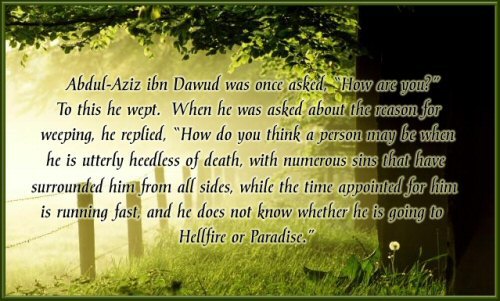
Burka Vs Bikini
By Henry Makow, Ph.D Written By a Non- Muslim Professor in America
On my wall, I have a picture of a Muslim woman shrouded in a burka. Beside it is a picture of an American beauty contestant, wearing nothing but a bikini. One woman is totally hidden from the public; the other is totally exposed. These two extremes say a great deal about the clash of so-called "civilizations."
The role of woman is at the heart of any culture. Apart from stealing Arab oil, the impending war in the Middle East is about stripping Arabs of their religion and culture, exchanging the burka for a bikini. I am not an expert on the condition of Muslim women and I love feminine beauty too much to advocate the burka here. But I am defending some of the values that the burka represents for me.
For me, the burka represents a woman's consecration to her husband and family. Only they see her. It affirms the privacy, exclusivity and importance of the domestic sphere. The Muslim woman's focus is her home, the "nest" where her children are born and reared. She is the "home" maker, the taproot that sustains the spiritual life of the family, nurturing and training her children, providing refuge and support to her husband. In contrast, the bikinied American beauty queen struts practically naked in front of millions on TV.
A feminist, she belongs to herself. In practice, paradoxically, she is public property. She belongs to no one and everyone. She shops her body to the highest bidder. She is auctioning herself all of the time. In America, the cultural measure of a woman's value is her sex appeal. (As this asset depreciates quickly, she is neurotically obsessed with appearance and plagued by weight problems.) As an adolescent, her role model is Britney Spears, a singer whose act approximates a strip tease. From Britney, she learns that she will be loved only if she gives sex. Thus, she learns to "hook up" rather than to demand patient courtship and true love.
As a result, dozens of males know her before her husband does. She loses her innocence, which is a part of her charm. She becomes hardened and calculating. Unable to love, she is unfit to receive her husband's seed. The feminine personality is founded on the emotional relationship between mother and baby. It is based on nurturing and self-sacrifice.
Masculine nature is founded on the relationship between hunter and prey. It is based on aggression and reason. Feminism teaches woman that feminine nature has resulted in "oppression" and that she should convert to male behavior instead. The result: a confused and aggressive woman with a large chip on her shoulder, unfit to become a wife or mother.
This, of course, is the goal of the social engineers at the NWO: undermine sexual identity and destroy the family, create social and personal dysfunction, and reduce population. (See http://www.inoohr.org/worldpopulationcontrolpromote.htm) In the "brave new world," women are not supposed to be nest makers, or progenitors of the race. They are meant to be neutered autonomous creatures that indulge in sex for physical pleasure, not for love or procreation.
At his press conference on Sunday, Donald Rumsfeld said that Iranian women and youth were restive under the rule of the Mullahs. He implied that the US would soon liberate them. To Britney Spears? To low-rise "see-my-thong" pants? Parenthood is the pinnacle of human development. It is the stage when we finally graduate from self-indulgence and become God's surrogates: creating and nurturing new life.
The New World Order does not want us to reach this level of maturity. Pornography is the replacement for marriage. We are to remain stunted: single, sex-starved and self-obsessed. We are not meant to have a permanent "private" life. We are to remain lonely and isolated, dependent on consumer products for our identity, in a state of perpetual courtship.
This is especially destructive for woman. Her sexual attraction is a function of her fertility. As fertility declines, so does her sex appeal. If a woman devotes her prime years to becoming "independent," she is not likely to find a permanent mate. Her long-term personal fulfillment and happiness lies in making marriage and family her first priority.
Feminism is another cruel New World Order hoax that has debauched American women and despoiled Western civilization. It has ruined millions of lives and represents a lethal threat to Islam. I am not advocating the burka but rather some of the values that it represents, specifically a woman's consecration to her future husband and family, and the modesty and dignity this entails. The burka and the bikini represent two extremes. The answer lies somewhere in the middle.
Henry Makow, Ph.D. is the inventor of the board game "Scruples" and the author of "A Long Way to go for a Date."
NOTE: As a Muslim, I do advocate Burqa (hijab) not just for the reasons this non-Muslim gives, but because it is a gift from Allah, providing us with a beautiful way to proclaim our belief in Him, our trust in His Wisdom, and in gratitude for the priceless gift of Islam. Ms. Carlo
¶
7:56 PM
//
LIFE.........
[Taken from al-Ghazali: Meditation and Introspection, The Book of Constructive Virtues, Ihya Ulum-id-din.]
¶
9:27 PM
//

The Concept of Mental Health in the Holy Qur'n and Hadith
ABSTRACT
Man is made up of body and soul. Each of these two components of man has its inmate needs. The body has its inmate needs that must be satisfied in order that the individual can live and the human species can survive. The soul also has its inmate needs that express themselves in man's spiritual longing for knowing God, belief in Him and worshiping Him. Satisfaction of these spiritual needs determines man's feeling of security and happiness.
Conflict arises between these two components of man. This conflict is, in fact, the basic psychological conflict that man suffers in his life. Perhaps, it is God's will that the way that man adopts in solving this conflict becomes the real test of man in this world. Those who really succeed in this test are those who can reconcile the material and the spiritual components of their personalities, and can establish the greatest amount of equilibrium between them. Therefore, they deserve the reward of being happy in this world and also in the later eternal life.
Islam follows in educating people a purposeful method that can establish equilibrium between the material and the spiritual components of their personalities in order to be normal persons who can enjoy mental health and happiness. Islam's method of education has two approaches. One is to strengthen the spiritual component in man by inviting him to believe in the only one God and to worship Him. The other approach is to ask man to dominate his material component by controlling his drives emotions and sensual desires. By these two approaches of education, Islam teaches people to attain equilibrium between the material and spiritual components of their personalities, and thus enjoy security, happiness and mental health.
¶
9:15 PM
//

Position of the Haafiz/a
His heart is actually chosen by Allah to preserve the Qur'aan. His mind is
illuminated with the brightness of the Qur'aan, his heart is perfumed with
the fragrance of the Qur'aan.
For every alphabet of the Qur'aan he had recited, he earned a minimum of ten
rewards. The maximum reward is best known by Allah. The Qur'aan has 6666
verses. Every verse has many alphabets. Imagine the number of alphabets a
Haafiz recites. On an average os 3 alphabets per verse a Haafiz will recite
approximately, 20 000 (twenty thousand) alphabets in the entire Qur'aan.
That multiplied by ten rewards per alphabet is 200 000 (two hundred
thousand). In the course of memorising the Qur'aan, a Haafiz makes great
sacrifices. He recites one verse very many times. If he had recited one
verse at least 10 times, the reward of completing the Qur'aan only once will
be two million. Imagine how many times thereafter, a Haafiz recites the Qur'
aan, how many Taraawees he performs, the rewards of all that is far beyond
our very limited comprehension. Probably, mathematival figures will be
exhausted but not the infinite rewards of Allah Ta'ala for a Haafizul Qur'
aan. In conclusion, consider the following Ahaadith:
Hadhrat Abdullah ibn Amr (Radhiallaahu Anhu) narrates that Rasulullah
(Sallallaahu Alayhi Wasallam) will say to a Haafiz (upon his death and on
the day of Qiyaamat) 'Recite the Qur'aan and (upon reciting each Verse)
climb (a stage in Jannah) and continue reciting as you used to in the world
as your abode in Jannah is upon the last verse you recite.' (Mishkaat vol.1
pg.186; Me'raaj)
Obviously, the Hafiz will stop at the last verse of the Qur'aan. The
commentators of Hadith have stated that the highest abode in Jannah is
equivalent to the number of verses in the Qur'aan. Therefore, upon
completing the recitation of the Qur'aan, a Haafiz will be in highest abode
of Jannah.
Mu'aadh al-Juhani narrates that Rasulullah (Sallallaahu Alayhi Wasallam)
said, 'Whosoever recites the Qur'aan and practices upon its injunctions, the
reciter's parents will be given a crown on the day of Qiyaamat. The
brightness of that crown will be more intense than the brightness of the sun
in your actual house.' Rasulullah (Sallallaahu Alayhi Wasallam) further
said, 'What do you think will be given to the Hafiz (reciter) of the Qur'aan
himself?' (Ibid).
¶
6:13 PM
//
Written in Stone, Tips on Memorizing the Qur'an
The battle raged on and the forces of Musaylimah AlKadhdhab were winning. The Sahabah could not lose; they would not lose. ‘Ammar ibn Yasser(RA) mounted a rock and called to all the Muslim fighters, “YAA HAMALAT ALQURAN!!” Oh carriers of the Qur’an!
He gathered a battalion of Sahabah that only consisted of the Huffadh. Every fighter at the side of ‘Ammar ibn Yasser had memorized the Qur’an in his heart. The battle was won!
Back to today. Have you ever been in a Masjid with elder respected members of a community, but when Salah time comes, a young unassuming brother steps forward from amongst everyone and leads the congregation? Why was this young boy honoured such? Someone whispers into your ear, “Oh, don’t you know? He memorized the Qu’ran by heart.”
Umar bin Al-Khattab (May Allah be pleased with him) reported: The Prophet (SAW) said, "Verily, Allah elevates some people with this Qur'an and abases others.'' [Muslim].
This article is meant [for] those who have taken their first steps, not those who are still waiting for motivation. It is dedicated to all our young brothers and sisters in Qu’ran Hifdh schools (and all the wannabes). Insha Allah, I will discuss how you can become more effective in your memorization of the Qur’an.
Let me ask this question, “Who wants to memorize the Qur’an?” No doubt, the hands initially will rise slowly, but then almost everyone should have their hand raised. But, most truthfully, is that desire a sincere, heartfelt desire? If it was, then action would follow. If I said, “Who wants to lose weight?” Most people would raise their hands and upon being asked would mention the steps they are taking to achieve their goal. What steps are we taking to memorize the Qur’an if indeed our intentions are passionate?
I would like to tell you a story of my own. A few months ago, I was sitting in a Halal chicken restaurant in Canada. All of a sudden, one of my classmates from the Qur’an school I went to when I was young entered. We hugged each other and sat together reminiscing about our days in Qur’an school. I told him about Allah’s blessings upon me and my family. He said to me, “Muhammad, I swear by Allah, I still remember the day when you came to the school and you couldn’t read alif-baa-taa correctly!” How best do we make use of our time?
We attend school for about 13 years. Then another 4 or 6 or 10 years at a University. More then 15 years of our life in such a slow process. Why? Because, we see the benefit of education for prosperity on earth. Why then do we not see such a rush to memorize the book of Allah? Perhaps the benefits are not readily apparent. Consider the following:
While other children are playing games and eating bubble gum, your child could be memorizing thousands of pages from the book of Allah. How does this benefit them? Quite obviously, the child’s mind is trained at such a young age to absorb information and facts. When the child who memorized the Qur’an is put in a class with bubblegum chewing/Playstation absorbed children, there is little doubt who will be the head of the class. Isn’t this what every parent wants?
Umar’s Dawee anNahl observed: What is our 'Goldness'? On the highway, it’s music and tv. Our golden generations were not golden because they watched tv and listened to music. They were golden because of their buzzing with the Qur’an.
When a young brother or sister is blessed with the gift of memorizing the entire Qur’an, it is a sign that Allah ta’ala loves them! Many humans chase after material wealth. They may achieve it, but that is not a sign that Allah loves them. Look at Fir’own, he had everything of the material world, but he was one of the most hated humans because of his actions.
Moses prayed: "Our Lord! Thou hast indeed bestowed on Pharaoh and his chiefs splendour and wealth in the life of the present, and so, Our Lord, they mislead (men) from Thy Path. Deface our Lord, the features of their wealth, and send hardness to their hearts, so they will not believe until they see the grievous penalty." [Qur'an 10:88]
And more than material wealth, what humans really want in life is significance and contribution. No one wants to live their life without having done something for their Deen and the betterment of life on earth. We want to leave a legacy.
With that in mind, notice the life of a Haafidh. From a very young age, he or she is pushed into a position of leadership. Consider it a mere 10% shift in their path. In the beginning it seems like a little, but after 20 or 50 years, it becomes a different destiny.
Notice the young brothers that memorized the Qur’an in your community, they are already pushed to the front of the congregation by virtue of their accomplishment. They, at this early start, are forced to contribute to the community and live a life of significance. Bi-idhnillah. That’s what we all want. The Qur’an can do it for you.
But these gifts have a condition: the taqwa of Allah. There is one absolute naseeha(advice) that will make or break the persons drive to memorize the Qur’an: One must desist from sin! Ibn Mas’ood said, “I feel that indeed someone will forget knowledge they had a acquired because of sins they commit.”
When Abu Haneefah(rh) was confronted with a Fiqh Mas’alah that he was unable to conclude, he would get up and pray two raka’at in tawbah to Allah. These are people who truly knew the prize to be won. Allah ta’ala teaches us in the Qur’an: [Be conscious of Allah and Allah will teach you.] This knowledge is from Allah ta’ala, a gift. It makes no sense that someone spends their nights disobeying the gift-giver while awaiting His gifts in the morning.
Al-Khateeb reported in al-Jaami’ (2/387) that Yahya ibn Yahya said: “A man asked Maalik ibn Anas, ‘O Abu ‘Abd-Allaah! Is there anything that will improve my memory?’ Maalik ibn Anas(rh) replied, ‘If anything will improve it, it is giving up sin.’” Bishr Alhaafee(rh) said, "A servant commits a sin, and is deprived [thereby] of performing tahajjud."
In this country, the wealthy are followed and studied. What are the secrets of massive accumulation of wealth? I wish someone would do a study on Huffadh. I’ve done my own surveying (albeit unscientific) of those who accomplished the memorization of the Qur’an. Every Hafidh I know has strong encouraging parents. I do not have any examples of anyone who memorized the Qur’an who has an irreligious family.
One parent I know has two and soon to be three, in sha Allah, of his children who memorized the Qur’an. I know you’re thinking, three! Hey share some of those kids with ours, that’s not fair. Well, I contemplated his situation. The father takes his children to class and at the same time, he tries his utmost to memorize the Qur’an himself. His children, day after day, see their father practicing his words. They don’t hear him say things like, ‘Hey kids, don’t be like me.’ Absolutely not.
The key: if you want your children to be effective in their Deen and their memorization of Qur’an, YOU have to be the one that you want your children to become. Do not let them see a contradiction.
When I was young, I did not want to go to a Qur’an school. Subhan Allah. I went to that Qur’an school, I went to Madinah University and here I am today. I recently received a beautiful email after giving a lecture to the Canadian Hujjaj, my father’s group. While I spoke, my father had his head up high, smiling and crying during the speech. The brother wrote in his email that he was watching my father during the lecture. It dawned on him that Muhammad is here today giving this speech because of the dua of this man! I hadn’t contemplated it much until I read that email, for indeed it is correct. After the tawfeeq of Allah, it was the dua of my parents for me that helped me become who I am.
Ibn `Abbas (RA) reported: The Messenger of Allah (SAW) said, “The heart that has no Qur’an in it is like an abandoned ruined dwelling.” [At-Tirmidhi]. What kind of home would you like your heart to dwell in? excusitis, is a most powerful sickness that keeps people back from accomplishing in life. Excuse-itis. If you interview effective people, you will rarely find them making excuses. If you want to succeed in your memorization, never make excuses. Do what you have to do. I forbid those around me from making excuses. I advise the same for you. Do what you have to do to accomplish. If you cannot, then do not make excuses.
One of the interesting excuses is “I have to completely understand the Qur’an before I memorize it. I have to know Arabic, and Fiqh and Hadith before I start from the source.” Do not look at what a scholar is currently reading or studying. Look at what he did in the beginning. Every single scholar I have ever met started with Qur’an, nothing else. If you want to accumulate massive knowledge of this Deen, you must begin with memorization of the Qur’an. The children in the Hifdh school are well on their way to accomplishing massive accumulation of knowledge of this deen by virtue of their Hifdh. Bi idhnillah.
Let me give you two views by two very different people and how they look at the challenges of life:
Person 1: “Oh man, that’s a killer. I can’t do that. This time I just give up. Looks like I’m finally whipped. I’ll never amount to anything. I’m tired.”
Person 2: “Awesome, that was the kind of challenge I’ve been waiting for. Yaa Rabb, I am going to make you proud of me. I’m going to give it my best. I’m going to pump 110% of my energy into every part of this challenge!”
Guess which one will succeed in their memorization of the Qur’an. That’s right, the second one. Why? Because the second one has the right attitude.
When I hear someone talking about their attempts to memorize Qur’an, I can usually tell which category they have locked themselves into. It is not the Qur’an. The Qur’an is easy to remember. Allah ta’ala testifies to that in the Qur’an: [And verily we made the Qur’an easy to remember, so is there anyone who will take heed?] If you think it’s easy for you, it is. If you think it is hard for you, it is. It is your attitude that determines it.
Below are some quick tips that will help you in memorizing the Qur’an:
You absolutely must have a teacher. Do NOT memorize on your own. You must have a teacher who you respect and whom you fear. Don’t ask ‘how’ to memorize the Qur’an. Ask where you can find the best teacher. The teacher will then guide you on the ‘how’.
Distractions. In memorizing the Qur’an, you must free your mind and environment of distractions. Imagine trying to memorize at a football game? Tough, huh? How about a theme park, could you sit down and control yourself to memorize? Probably not. Getting into a Qur’an Hifdh program with a teacher and discipline will assist you in creating the perfect atmosphere for memorization.
Memorize through Audio. A lot of people think they are memorizing the ‘look’ of the Mushaf, but actually you are memorizing the ‘sound’ of Ayat. When I review, I record my recitation on CD and listen to it again and again. The students that read the loudest in class are all the strongest students. Why? Because they can hear themselves the most?
When I was in Qur’an school, the boy beside me read so loud. I asked the teacher to ask him to read more quietly. He said a most powerful statement that became my motto: “No, you read louder!” I did and it benefited me unbelievably.
Location of the Mushaf. Your eyes follow a specific direction depending on what you are thinking or doing. If you are lying, your eyes go left. If you are remembering something visual, like where you left your keys, your eyes will look upwards.
When you memorize, the direction of memorization is right and left, not downwards. The mistake I see people make is that they put their mushaf low on the ground and then try to memorize. In order to fully harness the power of your mind, you must keep the mushaf at eye level, and not dip your head..
Eat brain food. We’ve all heard the advice of uncles that you have to eat Badams (almonds) to improve memory. Well, I’m here to tell you that the uncles were right! The food you eat, the drinks you drink, directly affect your ability to excel in memorization of the Qur’an.
Do not eat fatty, unhealthy food. Do not drink fizzy drinks. Eat a nutritious light breakfast, a nutritious light lunch, with almonds for snacks during the day. Subhan Allah, you will find you accomplish much more in your day.
Make everyday a victory. You can move a mountain rock by rock. Enjoy every page you memorize, every Ayah.
I am often asked about my secret to memorizing the Qur’an. They are expecting me to teach them a special ‘south-beach-hifdh-diet’ or something. (I call it tip shopping, they are expecting a specific tip). I say again and again, there is no doubt that there are three ingredients. If you have these three ingredients, you will accomplish what you set out for:
Dua, supplication (you must always reflect your desire to Allah).
Sabr, patience
Taqwa, protecting yourself from sin.
If you do not remember anything from this article except these three ingredients (DST – Dua, Sabr, Taqwa - DST) then, bi idhnillah, it will suffice.
`Abdullah bin `Amr bin Al-`As (May Allah be pleased with them) reported: The Prophet (SAW) said, "The one who was devoted to the Qur'an will be told on the Day of Resurrection: `Recite and ascend (in ranks) as you used to recite when you were in the world. Your rank will be at the last Ayah you recite.''' [Abu Dawud and At-Tirmidhi].
How many ranks will you climb on the Day of Resurrection?
How many ranks would you like to climb?
¶
9:52 PM
//
Labbaik Allahumma Labbaik!

A Short History of Hajj
Hajj and its rites were first ordained by Almighty Allah Jallah Wa'ala during the time of the Nabee lbrahim Alayhis Salaam [Abraham] and he was the one who was entrusted by Almighty Allah Azza Wajjal to build the Kaba'h - the House of Rabbul Ala'meen - along with his son Nabee Ismail Alayhis Salaam [Ishmael] at Makkah. Almighty Allah Tabaraka Wata'ala described the Kaba'h and its building as follows:
"And remember when We showed Ibrahim the site of the [Sacred] House [saying]":
"Associate not anything [in worship with Me and purify My House for those who ircumambulate it [i.e. perform tawaaf] and those who stand up for prayer and those who bow down and make prostration [in prayer etc.]."
[Surah Al-Hajj 22:26]
After building the Kaba'h, Nabee Ibrahim Alayhis Salaam would come to Makkah to perform Hajj every year, and after his death, this practice was continued by his son. However, gradually with the passage of time, both the form and the goal of the Hajj rites were changed. As idolatry spread throughout Arabia, the Kaba'h lost its purity and idols were placed inside it. Its walls became covered with poems and paintings, including one of Jesus and his mother Maryam and eventually over 360 idols came to be placed around the Kaba'h.
During the Hajj period itself, the atmosphere around the sacred precincts of the Kaba'h was like a circus. Men and women would go round the Kaba'h naked, arguing that they should present themselves before Almighty Allah in the same condition they were born. Their prayer became devoid of all sincere remembrance of the Most Glorious Creator and was instead reduced to a series of hand clapping, whistling and the blowing of horns. Even the Talbiyah was distorted by them with the following additions:
'No one is Your partner except one who is permitted by you.
You are his Master and the Master of what he possesses'.
Follow the Idol Breaker
One of the rituals of Hajj is the throwing of pebbles at the three pillars of temptation that symbolizes Shaytaan, when he tried to dissuade Nabee Ibrahim Alayhis Salaam from carrying out the command of Almighty Rabbul Ala'meen
The pile of broken umbrellas, huge rocks, and of course, rubber slip-ons of all hue piled around the pillars of temptation tell more than a story. The minor story of course is that some people come to Hajj unprepared and thus unaware what to hurl at Shaytaan. The major story is that why only small pebbles are needed. The questions, what to hurl and why only small pebbles are closely connected.
The completion of the rites of Hajj, as we know them, was executed by our Beloved Nabee Muhammad Sallallahoo Alayhi Wasallam after he removed all idols from the Kabah. The objects that needed major demolition equipment had been done away and what now remain are fresh idols that keep cropping up at all times. The need for heavy demolition equipment does exist, but the heavy-duty stuff that needs to be removed are not big rocks of idols, but the rocks of corruption, ego, greed, power, vanity, Fithnah and self-indulgence. The equipment needed to remove these rocks, are sincere doses of AllahConsciousness (Taqwa).
Nabee Ibrahim Alayhis Salaam (Abraham), perhaps, the foremost idol-breaker, launched a mission against idolatry when it was the absolute norm - he stood firm against the tide of idol worship and challenged this deep-rooted social norm. Today, we live amidst a tide of idols, however, these idols, although man-made like their predecessors, enjoy a form that is far more deceptive than the word idol usually conjures up for us. The modern day idols of the love for power, accumulation of earthly wealth or recognition is taking many forms, and most often these idols in the guise of current-day social norm are not only hurtful to the individual but indeed the
community.
Nabee Ibrahim Alayhis Salaam was confronted by the same psychological and emotional challenges that confront us: making and worshipping idols was the norm, and in his case the family's livelihood too. This is where his greatness lies that he was able to break from these barriers and demolish the idols. Yes, there was opposition, but none from within him. He felt no fear, no hesitancy in undoing his family's source of income. He was driven by a desire to break the shackles of idolatry and establish the worship of One true Creator - Almighty Allah Subhanahu Wata'ala.
The Jihad (struggle) of Nabee Ibrahim Alayhis Salaam is as relevant for us today, as it was thousands of years ago. Today, although it seems that no physical idols need be broken, but many idols confront us: there are still billions who are worshipping man-made idols, there are many who, drunk with power, are devastating human rights at will, and above all human beings live with false notions of wealth.
The popular ditty goes:
"What a tangled web we weave, when first we practice to deceive."
Humanity is held in deception and awaiting Muslims to break psychological and emotional idols and free themselves and the rest from this temporal world. To accept the Din of Al-Islam, one accepts the role and duty of Almighty Allah's trustee on this Doonya. Therefore, he or she remains accountable to Almighty Allah Azza Wajjal for the fulfillment of his or her obligations, to make the word of the Glorious Creator and Sustainer supreme and to free men, all men, from the yoke of slavery of other men to the slavery and service of Almighty Allah Jallah Wa'ala.
"And those who strive hard for Us, We shall certainly guide them in Our Ways, and Allah is surely with the doers of good."
[Verse 69 Surah Al 'Ankabut].
"And if Allah is your helper, none will overcome you and if He withdraws His help, who then can help you? In Allah let the believers put their trust."
[Verse 16 Surah Al-Imran].
Hajj teaches us that Islam is the Din of Almighty Allah Subhanahu Wata'ala. The Din of Al Islam was, is, and will forever remain a movement of the liberation of man from all kinds of enslavements of mind and body, liberation from the worship of all false gods, earthly and heavenly, freedom from political, economic and religious despotisms.
Let us, therefore, take our guidance from the message of Islam, build our character as true, sincere, dedicated and confirmed Muslims and quicken our pace of spiritual progress until we attain our rightful place as the Vice-gerents of Almighty Allah Jallah Wa'ala on this Doonya.
Ameen!
Baarak Allaahu Feekum wa-Sal Allaahu wa-Sallam
'alaa Nabiyyinaa Muhammad Sallallahoo Alayhi Wasallam.
Was Salaamualaykum Warahmatullahi Wabarakatuhu.
Abdul Hamid
¶
8:32 PM
//